
Examining the possible involvement of Repton in the landscape of Knepp Castle ?
And of course, the case against . . .
To quote the website of parksandgardens.org
“The pleasure grounds which were possibly designed by Humphry Repton”
This record was created on the 27/07/2007 – but by whom ?
And ‘possibly’ ? What did they mean ? How did they reach that conclusion?
There are not many places where nature has, completely unaided, created a landscape so perfect as that of Knepp Castle. It looks like an idealised page from one of Repton’s Red Books. The lawns sweeping down to the lake, the framing trees, the distant view of an ancient ruin, the herd of grazing deer. Surely on visual evidence such as this – there must be a case ?
But what is there that might substantiate Repton’s hand ?
All archival records pertaining to Knepp were lost in a disastrous fire that gutted the house in 1904, so it remains entirely speculative, and the object of this paper is to explore the possibility.
Charles Merrick Burrell had inherited the Knepp estate on the death of his father in 1796 .
The house was designed by John Nash in the gothic style, and the dates given by Historic England are 1806 – 1813, which presumably covers concept to completion ?
With Nash as architect perhaps it was assumed that Repton had a part in the landscape ?
But the partnership between Repton and Nash, commenced in 1795, was over by 1800 and particularly since their parting was said to be acrimonious, it is hardly likely that Nash would have suggested involving Repton in the Knepp estate ?
However, this may not have been an obstacle to Charles Merrick Burrell contacting Repton directly ?
Certainly many of the Sussex gentry had consulted Repton during the period that the new house at Knepp was under discussion and built, and it is reasonable to assume that many of them would have been known to the Burrell family.
Charles Merrick Burrell’s father, William Burrell, a keen local historian, was a rector of Brightling and therefore must have been well known to John Fuller, who employed Repton to make proposals for his Rose Hill estate. Both William Burrell and John (Mad Jack) Fuller (1757- 1834) were active patrons of the arts and both commissioned Heironymus Grimm to make drawings of their estates.
Charles Merrick Burrell was MP for New Shoreham from 1806 until his death in 1862. Among Repton’s many clients in Sussex, was Charles Abbot of Kidbrooke Park, who was Speaker of the House of Commons from 1802 -1817, so it is very likely that the two men were acquainted. Charles Merrick married Frances Wyndham, the daughter of George O’Brien Wyndham, 3rd Earl of Egremont of Petworth House and all his female cousins married into the aristocracy.
So there is no doubt as to the family connections within Sussex society and its landscaping ambitions, which frequently involved Mr. Repton.
But what else ?
The publication of Repton’s ‘Theory and Practice of Landscape Gardening ‘ in 1803 and his contributions to the annual ‘Peacock’s Polite Repository’, between 1790 and 1808, meant that his concepts were reaching an ever wider audience. No land-owning gentleman can have been unaware of Repton’s ideas and subsequently have been influenced by them.
Was that all it took ?
At the time that Knepp was under construction, Repton’s son, George Stanley, was working in Nash’s office preparing drawings for a new house at West Grinstead Park, owned by Charles Merrick’s brother, Walter. The two estates of Knepp and West Grinstead were adjacent, only separated by the London to Worthing road. During this period Repton frequently worked closely with both his sons, John Adey and George Stanley, notably on the drawings for the Royal Pavilion at Brighton. So close by.
Walter chose to build his house with stone but Charles Merrick, more frugally, used bricks that could be made on site and timber from his estate. Does this show a difference in attitude to money ? Perhaps it was deemed unnecessary to go to the expense of employing Repton to make a Red Book ?
Knepp was fortunate in having the existing expansive ‘Knepp Pond’ within the estate. This had been dug in the 16th C by the Duke of Norfolk to form a ‘hammer pond’, providing water-power for the local iron industry. So, there was no need for the expensive and time consuming work of earth removal and the dam was already in place. There was also the Norman ruin of Old Knepp Castle to serve as a suitable eye-catcher within the estate. Positioning the house with a view over this body of water and towards the ruin was an obvious choice.
Indeed the advantages of the site had been specifically noted in the sale particulars of the estate in 1787, which stated, “at a proper distance from the Turnpike Road, is an ELEVATED AND BEAUTIFUL SPOT, to build a house upon, and which would command uninterrupted Views over the whole Estate , and the adjacent country of the SOUTH DOWNS ”
The estate was bought at auction by Sir Charles Raymond, Sophia Burrell’s father. Possibly with the intention of leaving it to his daughter and her husband ? Its potential had certainly been recognised by William Burrell, who had commissioned a drawing by Hieronymus Grimm from this vantage point in 1784, showing the view of West Grinstead Church and the picturesque ruin of the old Norman Castle from the position that the new house was ultimately built. In 1788 Sir Charles Raymond died and the Knepp estate, together with the baronetcy, passed into Burrell family.
So it seems clear that the aesthetics of the landscape at Knepp were clearly understood by the family and quite possibly there was already an intention to build a house there.
But also that there was plenty of opportunity for Repton, or his sons, to have visited the Knepp site should it have been requested.
But there is one factor which might have influenced Charles Merrick Burrell against involving Repton. His Uncle, Peter Burrell, who lived at Langley Park in Kent, had commissioned Repton in 1790 to make a Red Book for his park and a prospective new house. Could something have happened that soured relationships between Repton and the Burrell family ?
Or did they simply decide that they had no need of Repton ?
Is it possible that Nash advised on the landscape ?
Certainly someone made decisions that completely altered the appearance of the Knepp estate in the early years of the 19th C.
Prior to the Burrells ownership of the land, in 1754 a detailed survey had been made by James Crow. This map shows that the estate was purely agricultural, divided into fields with hedgerow boundaries and it is reasonable to assume that it had continued as such. But in 1806, right at the point that the site for the new house had been decided and building was due to begin, the Ordnance Surveyors Draft was made and clearly shows that the field boundaries have been removed on the east side of Knepp Mill pond, leaving only the standard hedgerow trees.
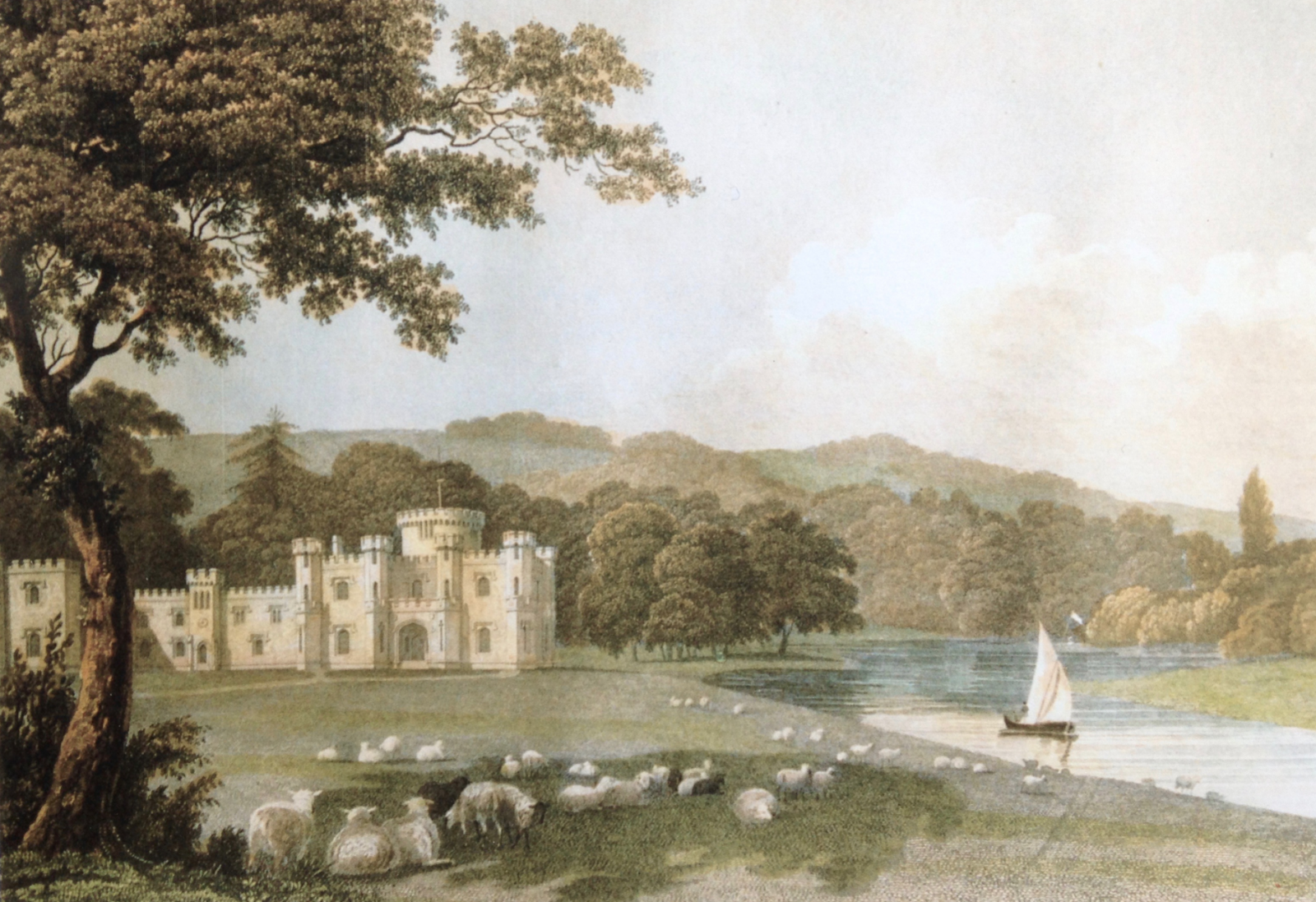
The area is surrounded by judicious belts of planting, screening the road and adjacent farms from view. This can only have been undertaken to create a parkland setting for the new house and take best advantage of its picturesque qualities. By the time the house was completed the same process of hedgerow clearance had been done on the west side of the pond and a ha-ha had been built, separating the ‘dressed ground’ around the house from the sward of grassland towards the lake. This area is shown, animated with sheep, in Lady Burrell’s watercolour of 1830.
Perhaps the pleasure ground was also made at this time ? The first Edition OS map of 1875 shows informal paths laid out through woodland to the north of the house. Close by, the walled kitchen garden had been built and could have provided a sheltered walk ? As Repton wrote, in 1806 , “There are many days in winter, when a warm, dry, but secluded walk, under the shelter of a south wall, would be preferred to the most beautiful but exposed landscape ; and in the spring, when on the south border of a walled garden some early flowers and vegetables may cheer the sight, although every plant is elsewhere pinched with the north east winds peculiar to our climate in the months of March and April” * Did the Burrell family follow this suggestion ?
It’s also interesting to speculate as to when ‘Ladies Walk’, which takes a path to view the ruin of old Knepp Castle, was made ? Although the name doesn’t appear on any extant plans until the OS map of 1875, well after Charles Merrick had died (1862) , it seems most likely that it belongs to the early phase of landscape improvements made to the estate.
But the map also shows a new plantation of trees on the far side of Castle Lane which, as they grew, would have blocked the view of the ruin from the house. By 1875 neither of Charles Merricks’ sons were living at Knepp Castle. Landscape fashions had changed and this indicates that perhaps the estate was now being managed for profit rather than aesthetics ?
On balance it seems that although there is nothing to substantiate Repton’s direct involvement with the creation of the landscape at Knepp Castle it remains a vibrant testament to his ideas and influence. With the re-wilding process, begun in 2010 by the current Charles Burrell, the landscape of his forebears has been unexpectedly revived. To visit Knepp Castle today is to visit a magnificent landscape that is as much of the 21st century as it is of the Georgian period.
. .
Maps consulted
1754 Crow Survey
1806 Ordnance Surveyors Draft
1825 Greenwood Survey
1875 OS map
’An Enquiry into the Changes in Taste in Landscape Gardening’
With thanks to Colston Stone for material from their Report of 2000