
This journey was inspired by Laurie Lee’s book, ’When I Walked out One Midsummer Morning’. The descriptions of the towns and landscape he travelled through as he walked across Spain were so evocative that I had to visit them for myself. Being of the twenty-first century, I elected to fly to Madrid and go from there with a hire car. The ancient towns were my focus but I had to include gardens when the opportunity was there.
It was early Spring and our first stop was Toledo.
Golden and proud Toledo stands magnificent. Sited on a promontory of rock, defended by the encircling gorge of the river Tagus. Today you park your car outside of this naturally well-guarded fortress and take a series of escalators to reach the town. Its streets are narrow, steep and cobbled. The town is dominated by the Cathedral, seemingly always bathed in sunlight, which you glimpse obliquely at every turn. It’s a wonderful town just to wander, with no particular purpose. The buildings show the Moorish origins of the town.and the stonework is unique. The traditional houses have heavy wooden doors thick with metal studs. They open onto courtyards full of plants, with steps leading up to a timber balcony at first floor level. The ceilings are carved and painted and tiles decorate the walls.
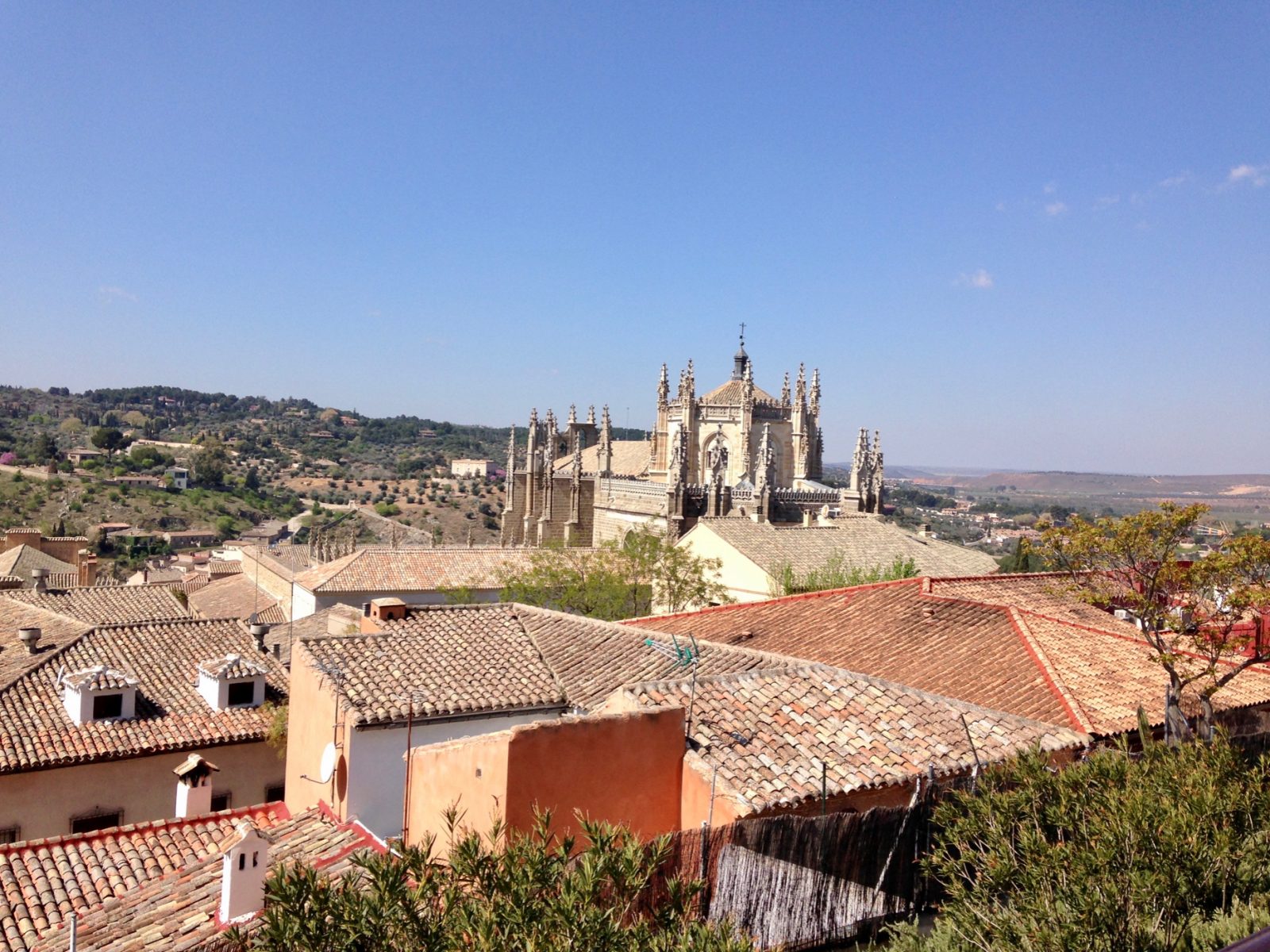
We visited ‘El Greco’s’ house, a restored 15th C town house in the Jewish quarter, now a museum with a collection of 15th / 16th C paintings. In a separate room is El Greco’s Apostolate. By comparison with his contemporaries these paintings are startlingly modern, they glow with light and are quite mesmeric. There’s a pretty garden attached to the house and the wistaria was out. So we sat in the sun and enjoyed the peace.
The Royal Palace of Aranjuez is a drive away from Toledo, east across the Castilla-la-Mancha plain. The Gardens of Aranjuez are made up of three separate areas, as you enter the garden there is the exquisite Parterre Garden alongside the palace, a huge weir controls the river and directs waterinto a canal around the palace.
Beyond you wander through miles of rather sad looking box-hedging, occasionally intersected by large, sadly dry, classical fountains and on into the Island Garden where there is more of the same. The French influence which originally articulated the gardens at conception has been lost.
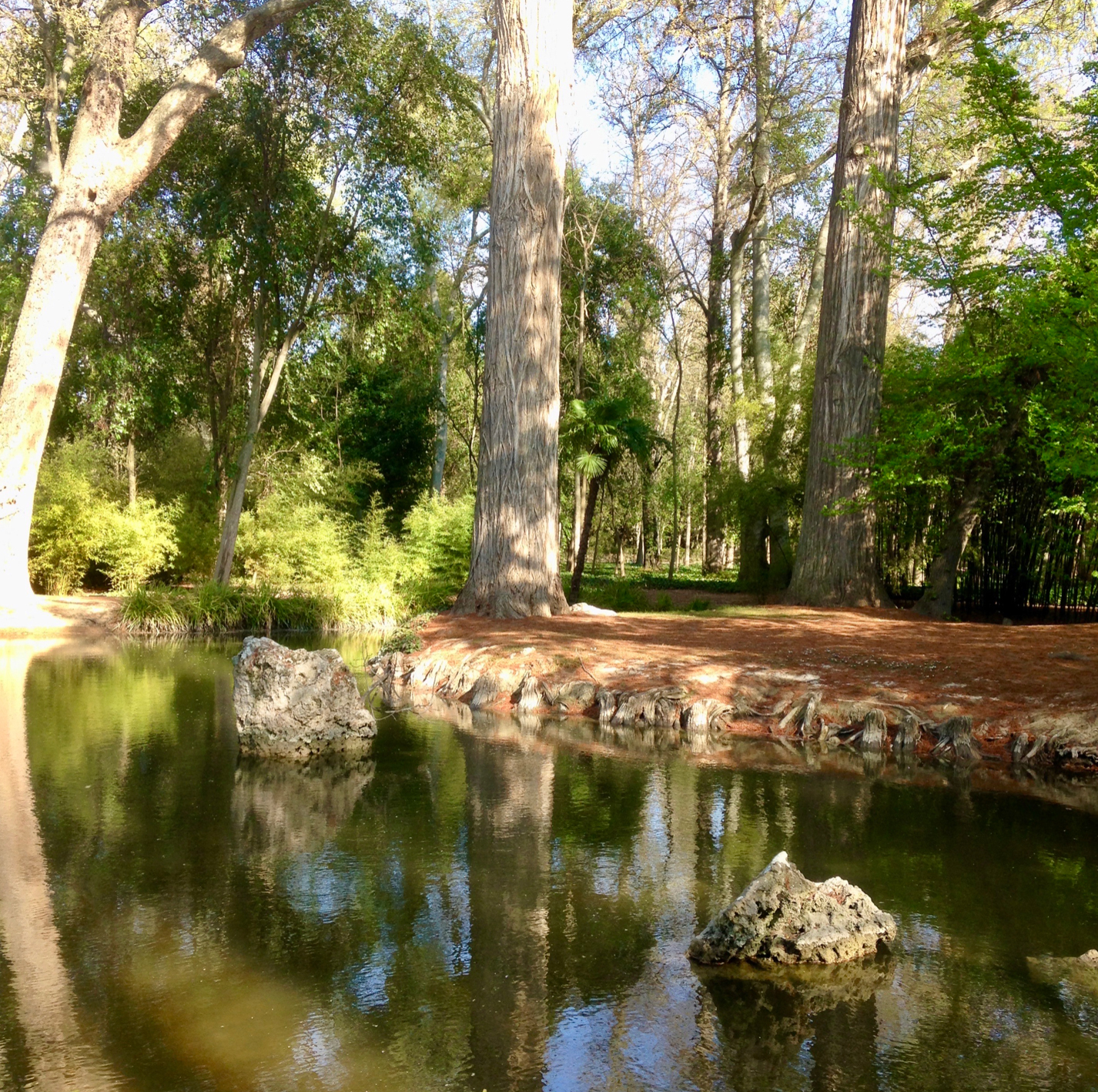
I much preferred the extensive Jardin del Principe on the other side of the river. Avenues of enormous trees were coming into leaf, interspersed with Cercis siliquastrum whose purple petals shone through the new greens. A Chinoiserie pavilion sits alongside a classical temple and a marvellous group of Swamp Cypress bathe their feet in their surrounding pool .
The sun was low as we drove back and the ostensibly flat Castillian plain was a colourful abstract with the mountains dark in the distance.
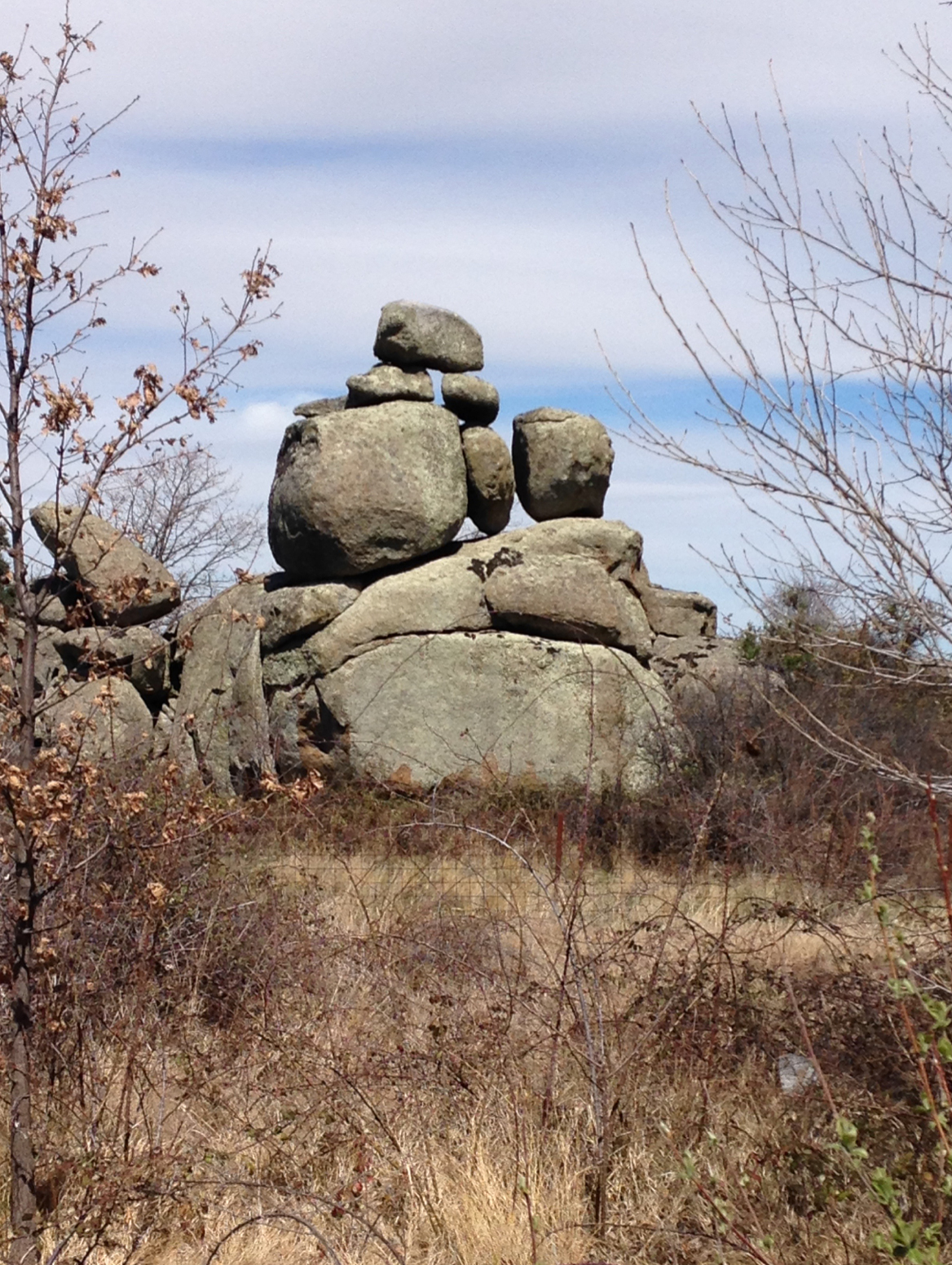
The following day we travelled on to Salamanca travelling over country roads with no traffic and extraordinary rocks weathered to sculpture.
In Salamanca we were staying right in the centre of town. Within easy distance of all the major
sights. The two Cathedrals of Salamanca are built side by side, the new not destroying the older building but creating a link into it. The new Cathedral was consecrated in 1733 and is ostentatiously ornate but as soon as I passed into the older building there was a deep shift in atmosphere. Wonderful wall paintings and colourful wall tombs, and a sense of peace.
My favourite building was the Casa de las Conchas, built at the end of the 15th C with a facade decorated with 300 scallop shells, a superb central courtyard and wide stone staircase. It is now a public library, so access is not difficult. But the star of Salamanca is its 18th C huge central square, Plaza Major, allegedly the largest in Europe. Arcaded and lined with shops and cafes, and decorated with medallions of Spanish rulers. At night it is lit and looks spectacular.
We left for Segovia on a grey overcast day. Once again following country roads where feasible, and coming into the town on the old road that brings you in through a stone archway and beneath the exquisite Alcazar, exactly as the 1838 engraving shows.
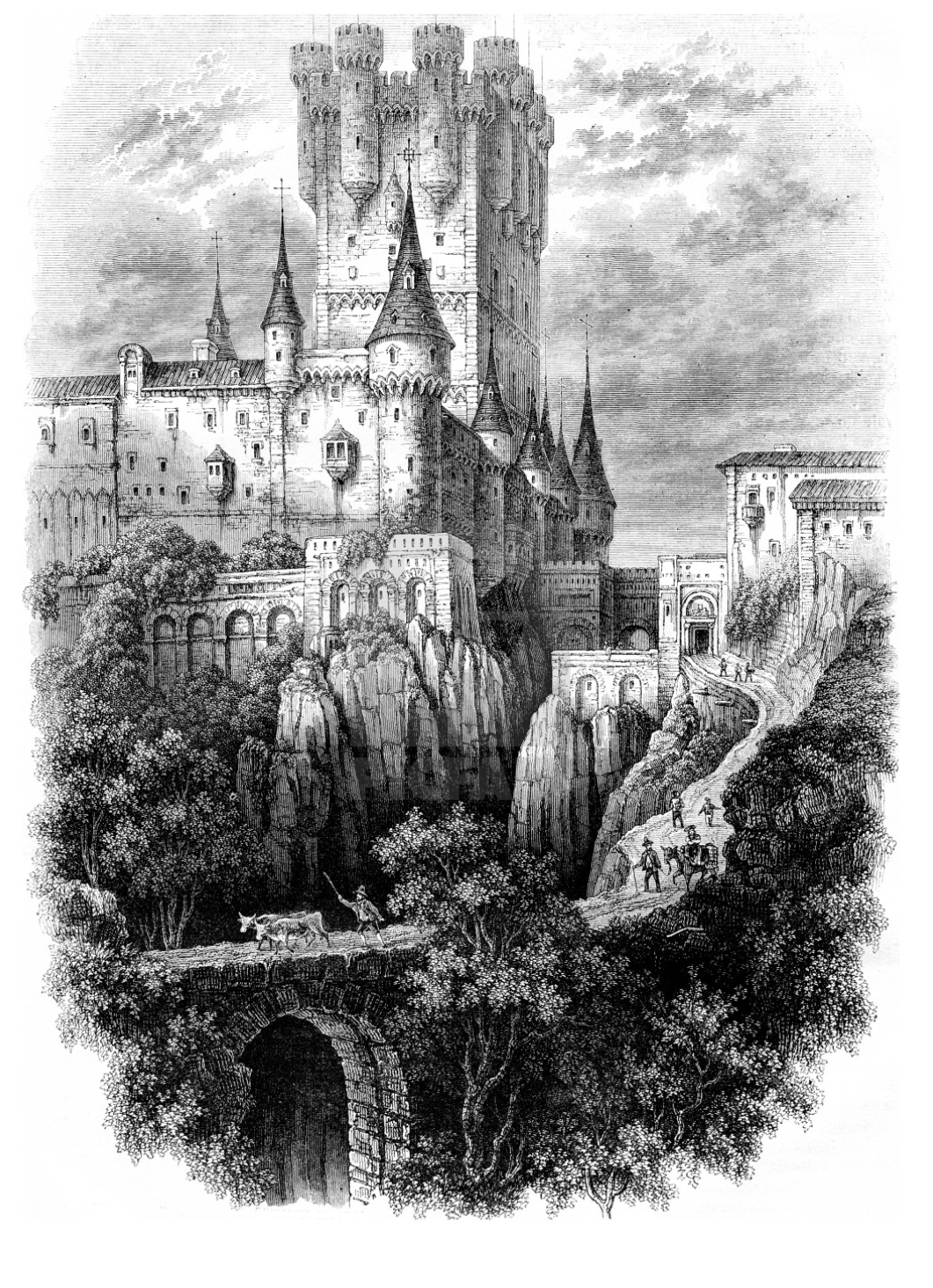
We stayed at Don Jaime, a lovely little hotel with a superb view of the aqueduct that bisects the town and a church tower thatched with storks nests.
The following day we went to El Escorial. A rather forbidding palace with restricted access to the garden area – even the windows looking out over the gardens had been obscured, so there was no possibility of taking photographs. The only allowable area was the box parterre of the Monks Garden which was well maintained, but the garden had clearly extended over a much larger area, and must be awaiting a big reconstruction project.
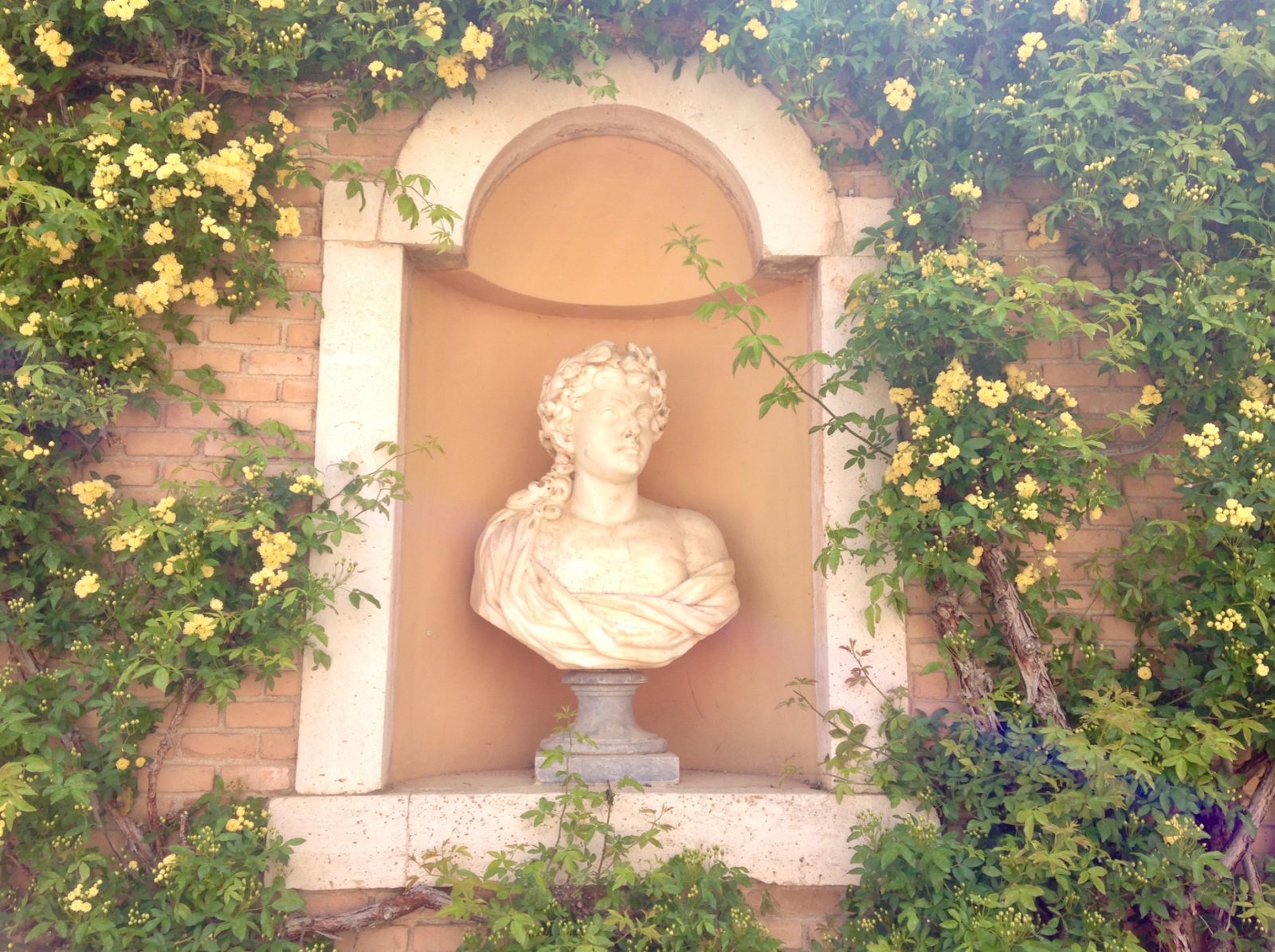
Far prettier and more charming was the Casita de Principe, a little jewel box of a house dating from 1770, enclosed by a beautifully designed garden embedded in a large wooded park. There were formal groves of quince trees, grand cedars, fountains, curvaceous parterres, and stone walls with roses on treillage. Quite beautiful. Fortunately I saw it in sunshine, but we drove back over the mountains to Segovia through a snowstorm.
The Monasterio de Piedra at Nuevalos is in the arid mountainous region of Zaragosa. The ancient monastery is now converted to a hotel, with wonderful huge high domed ceilings, long quiet corridors (decorated with 19th century engravings of all the places we had been visiting) and huge ensuite rooms with big balconies overlooking the exceptional ‘garden’
The ‘garden’ is an extraordinary natural phenomena of cascades, waterfalls, and caves created by the River Piedra. The River Piedra (Stone River) is so called because its lime-bearing water lays down tufa, creating great mounded pillows of rock which the river pours over with seemingly endless profusion. In the 1860’s this area was sensitively developed into a landscaped park with paths, tunnels and bridges which allow one to experience this incredible site where water fills every sense !
The last garden we visited on this trip is in a remote area of the Pyrenees. It is a garden made by none other than Antoni Gaudi.. I had been several times before as I think it is an extraordinary piece of design and an amazing survival.
The garden was made in 1904 for Joan Artigas i Alart, who offered Gaudi his hospitality while he was building the Catllaràs refuge for the engineers of the mine belonging to Guell. It is contemporary with the work on Guell Parc and has elements in common with it.
Surrounded by the grandeur of the Pyrenees the garden spans the little valley of the River Llobregat. Intimate, domestic in scale and full of detail.
It’s a garden whose form can only have been derived from walking the valley and looking and thinking and letting the space speak for itself.
There is a bridge that crosses the valley, which if you stand and look back up towards the mountain you can see that it lines through with a broad fault line where the rock has formed two parallel lines. This must have been observed by Gaudi as a visual landmark worthy of attention. It makes one aware of the physicality of both the designer and the place. The bridge itself is organic in form and supports a little stone turreted gloriette, only big enough for two, or perhaps three people. Inside there is a table made from a large tree trunk and windows that allow you to peer out over the river below. I would like to write more about this garden and the landscaping work of Antoni Gaudi.